In order to maximize engine performance, we have read a lot of materials and watched a large number of high-performance engine videos to understand the physical characteristics and working principles of cylinder liners and pistons in high-performance engines. A good combustion chamber can not only improve combustion efficiency, but also provide more powerful engines.
The combustion chamber kit includes cylinder liners, pistons, piston rings, oil rings, connecting rods, connecting rod bushings, piston pins, and piston pin retaining springs. Each component is made of high-quality materials and meticulously crafted through multiple processes.
Combustion chamber kit diagram
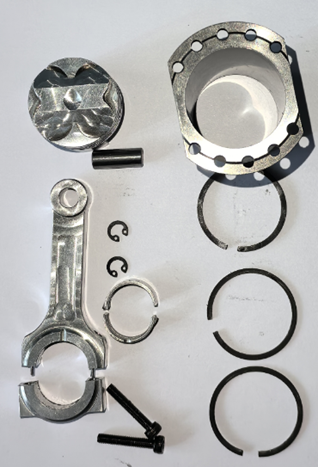
In order to improve the power and efficiency of the engine, a valve avoidance pit and spark concentration zone were designed for the piston constructively, and the piston was treated lightly. The cylinder liner adopts hollow wet cylinder liner and cylinder liner flange water hole design, which not only improves the heat dissipation efficiency of the engine, but also ensures that the cylinder liner is not easily deformed after the engine is hot. The connecting rod is designed with bearing shells, which are machined with oil. The connecting rod is also equipped with locating pins to ensure sufficient lubrication and installation accuracy.
The design of the anti valve pit improves the compression ratio of the engine while allowing for free movement, avoiding interference with components such as pistons, valve springs, and valve guides.
The main advantages are as follows:
1. Avoid interference: The valve pit provides a space for the valve to move, ensuring that the valve does not collide with the piston crown or other components when opening and closing.
2. Optimizing airflow: By appropriately designing valve traps, the flow path of the airflow can be optimized, improving the combustion efficiency and performance of the engine.
Spark concentration zone refers to the area in the combustion chamber of a gasoline engine where spark energy is most concentrated when the spark plug ignites. This area is the critical location where the fuel mixture is ignited, which has a significant impact on the combustion efficiency and emission performance of the engine.
The main advantages are as follows:1. Combustion efficiency: The location and intensity of the spark concentration zone directly affect the combustion efficiency of the fuel. If the spark concentration area is too dispersed or the intensity is insufficient, it may lead to incomplete combustion and reduce engine efficiency.
2. Emission performance: The optimized design of the spark concentration zone helps reduce the emissions of unburned fuel and harmful gases.
3. Engine performance: A well-designed spark concentration zone can improve the power output and responsiveness of the engine.
Wet cylinder liner is a type of cylinder liner design in internal combustion engines that directly contacts the coolant and is used to cool and support the movement of the piston. Compared with dry cylinder liners, wet cylinder liners have better cooling effects because they allow coolant to flow directly through the outer surface of the cylinder liner, thereby more effectively removing heat.The main advantages are as follows:
1. Cooling effect: Wet cylinder liners allow the coolant to directly contact the cylinder liners, resulting in better cooling effect and helping to maintain the normal operating temperature of the engine.
2. Installation method: Wet cylinder liners are usually installed on the cylinder block through special seals, which can prevent coolant leakage.
3. Material: Wet cylinder liners typically use corrosion-resistant and high-temperature resistant materials, such as cast iron or aluminum alloy.
4. Maintainability: Wet cylinder liners are usually easier to replace than dry cylinder liners because they do not require a tight fit with the cylinder block.
The connecting rod bearing and locating pin are key components of the connecting rod assembly in internal combustion engines, which work together to ensure smooth operation and good lubrication between the connecting rod and crankshaft.Connecting rod piston diagram
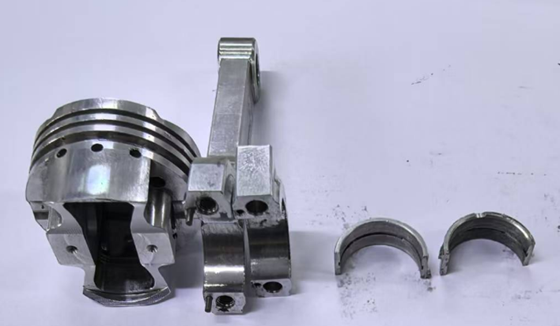
Function of connecting rod tile:
1. Supporting connecting rod: The connecting rod bearing supports the large end of the connecting rod, allowing it to rotate smoothly on the crankshaft.
2. Reduce friction: The connecting rod bearing reduces friction between the connecting rod and the crankshaft by providing a smooth contact surface and oil film.
3. Transmission of power: The connecting rod bearing converts the reciprocating motion of the piston into the rotational motion of the crankshaft, transmitting power.
4. Heat dissipation: The connecting rod tile takes away some heat through lubricating oil to help dissipate heat.
Positioning sales function:
1. Fixed connecting rod big head cover: The locating pin firmly fixes the connecting rod big head cover on the connecting rod big head, ensuring the integrity of the bearing.
2. Transmitting torque: The positioning pin transmits the torque generated by the piston and connecting rod to the crankshaft.
3. Sealing: The fastening force of the locating pin ensures the sealing between the connecting rod big end cap and the connecting rod big end, preventing lubricant leakage.